
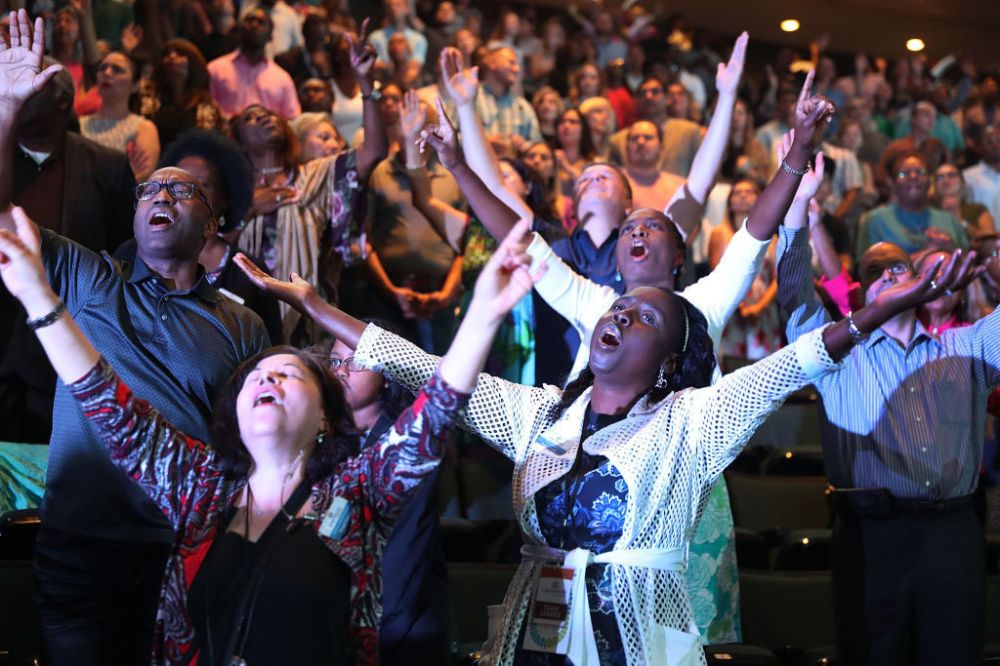
Photo credit: Pinterest
“About midnight Paul and Silas were praying and singing praises to God, while the other
prisoners listened. Suddenly a strong earthquake shook the jail to its foundations. The doors
opened, and the chains fell from all the prisoners.” – Acts 16:25-26 (CEV).
What is Praise?
The Easton Bible Dictionary defines praise as expressing commendation, admiration, or
gratitude, often involving glorifying and extolling God for His perfections and works. It is an
acknowledgment of God’s value, a form of thanks for His blessings, and can be expressed
through words, song, or other acts of worship.
Praise is an acknowledgment of God’s value; glorifying and extolling Him for His perfections and works.
The Holman Bible Dictionary further adds that praise is one of humanity’s many responses to
God’s revelation of Himself. While the Bible primarily focuses on praising God, it recognizes that
people may also be the objects of praise, either from others (Proverbs 27:21; Proverbs 31:30)
or from God Himself (Romans 2:29). Angels and the natural world are likewise depicted as
praising God (Psalm 148:1-2).
Nevertheless, human praise of God is one of Scripture’s major themes. The word “praise”
comes from a Latin root meaning “value” or “price.” Thus, to give praise to God is to proclaim
His merit or worth.
Praising God in the “Midnight Season”
Having looked at what praise is, we must now consider that praising God during the midnight
season of one’s life is not the easiest thing to do. Imagine Paul and Silas praising God from a prison cell following an unjust incarceration. In our opening text, they had every reason to be grumpy and moody, yet they chose to pray and sing praises to God—and suddenly, an earthquake shook the jail to its foundations, setting them free!
Praising God during the midnight
season of one’s life is not the easiest thing to do.
It’s easy to sing praises when things are going well; anyone can praise God after a major
breakthrough. But to praise Him following a setback, a breakup, or a breakdown? That’s
something else entirely. When we find ourselves in a valley, our prayers can easily descend into
complaints and a pity party if we don’t guard against it.
In true praise, we celebrate God’s faithfulness. We acknowledge His goodness and mercies,
appreciate His kindness, and declare His almightiness. A heart of gratitude naturally ushers us
into the frequency of praise. Expressing gratitude to God in our midnight season is the last thing
the devil would expect from us, and it is the one thing that always moves God on our behalf.
When we find ourselves in a valley, our prayers can easily descend into
complaints and a pity party if we don’t guard against it.
The Power of Praise in Action
A very interesting story that highlights the power of praise is found in the twentieth chapter of
the second book of Chronicles, where the armies of Ammon, Moab, and Mount Seir marched
against King Jehoshaphat and the army of Judah.
After seeking the face of the Lord in prayer, Jehoshaphat, in verse 21 of the passage, appointed
singers to walk ahead of the army of Judah, singing to the Lord and praising Him for His holy
splendor. And the Lord fought on their behalf. The Lord caused the three armies to attack and
utterly destroy each other—not a single enemy escaped. It took King Jehoshaphat and his men
three days just to gather the plunder from the battlefield.
No wonder Exodus 15:11 says, “Who is like unto thee, O Lord, among the gods? Who is like
thee, glorious in holiness, Fearful in Praises, doing wonders?” Our God is indeed fearful in
praises.
The Unique Nature of Praise
There is something unique about praise that makes it so powerful. Psalm 22:3 gives us a hint
when it says that God “inhabits” the praise of Israel. Isn’t it interesting that King David describes
God as dwelling amid—or being enthroned upon the praises of His people. Imagine the
almighty Himself, sitting enthroned on the praises of His people.
Psalm 67:5-6 also highlights the unusual power of Praise, it says “Let the people praise thee, O
God; let all the people praise thee. Then shall the earth yield her increase; and God, even our
own God, shall bless us.” Wow! Even the earth yields its increase in response to praise.
Again, Psalm 100:1-4 in The Message translation gives us an idea of the unique role of praise:
“On your feet now—applaud God! Bring a gift of laughter, sing yourselves into his presence.
Know this: GOD is God, and God, GOD. He made us; we didn’t make him. We’re his people, his
well-tended sheep. Enter with the password: “Thank you!” Make yourselves at home, talking
praise. Thank him. Worship him.”
Through praise, we make ourselves at home in God’s presence!
Enter with the password: “Thank you!” Make yourselves at home, talking
praise. Thank him. Worship him.”
The Garment of Praise
Praise is also likened to a garment we put on. The Bible, in Isaiah 61:3, says: “To appoint unto them that mourn in Zion, to give unto them beauty for ashes, the oil of joy for mourning, the garment of praise for the spirit of heaviness; that they might be called trees of righteousness, the planting of the Lord, that he might be glorified.” Praise, in this passage, is likened to a garment that God gives to His children in place of the spirit of heaviness. This means you can consciously and intentionally “wear” praise everywhere you go, at any time of the day, just like you can wear an attitude.
However, for us to tap into the enormous power available in praise, our praise to God must be
offered cheerfully, in reverence to God, and from a pure heart with clean hands. Even in the
“midnight seasons” of our lives when it might not be convenient to offer praises unto God.
Psalm 24:3-5 reminds us of this requirement: “Who may ascend the mountain of the Lord?
Who may stand in his holy place? The one who has clean hands and a pure heart, who does not
trust in an idol or swear by a false god. They will receive blessing from the Lord and vindication
from God their Savior.” Similarly, Psalm 119:7 adds, “As I learn your righteous judgments, I will
praise you with a pure heart.”
You can consciously and intentionally “wear” praise everywhere you go, at any time of the day, just like you can wear an attitude.
David: The Sweet Psalmist
Finally, the life of King David in the Bible gives us a clear picture of the power of praise. One of
the major things David was known for was his dedicated life of praise. He wrote almost half of
the book of Psalms, and in his last words, captured in 2 Samuel 23:1, David referred to himself
as the Sweet Psalmist of Israel. No wonder God called David a man after His own heart and established a covenant with him that secured his throne for all generations. This covenant is detailed in 2 Samuel 7:12-16 where God said:
“When your days are over and you rest with your ancestors, I will raise up your offspring to
succeed you… I will establish the throne of his kingdom forever… Your house and your kingdom
will endure forever before me; your throne will be established forever.”
God fulfilled this promise to David through our Lord and Savior Jesus Christ, as announced in
Luke 1:32 where the Angel Gabriel said to a virgin named Mary, “He will be great and will be
called the Son of the Most High. The Lord God will give him the throne of his father David.”
 World Changers Magazine