
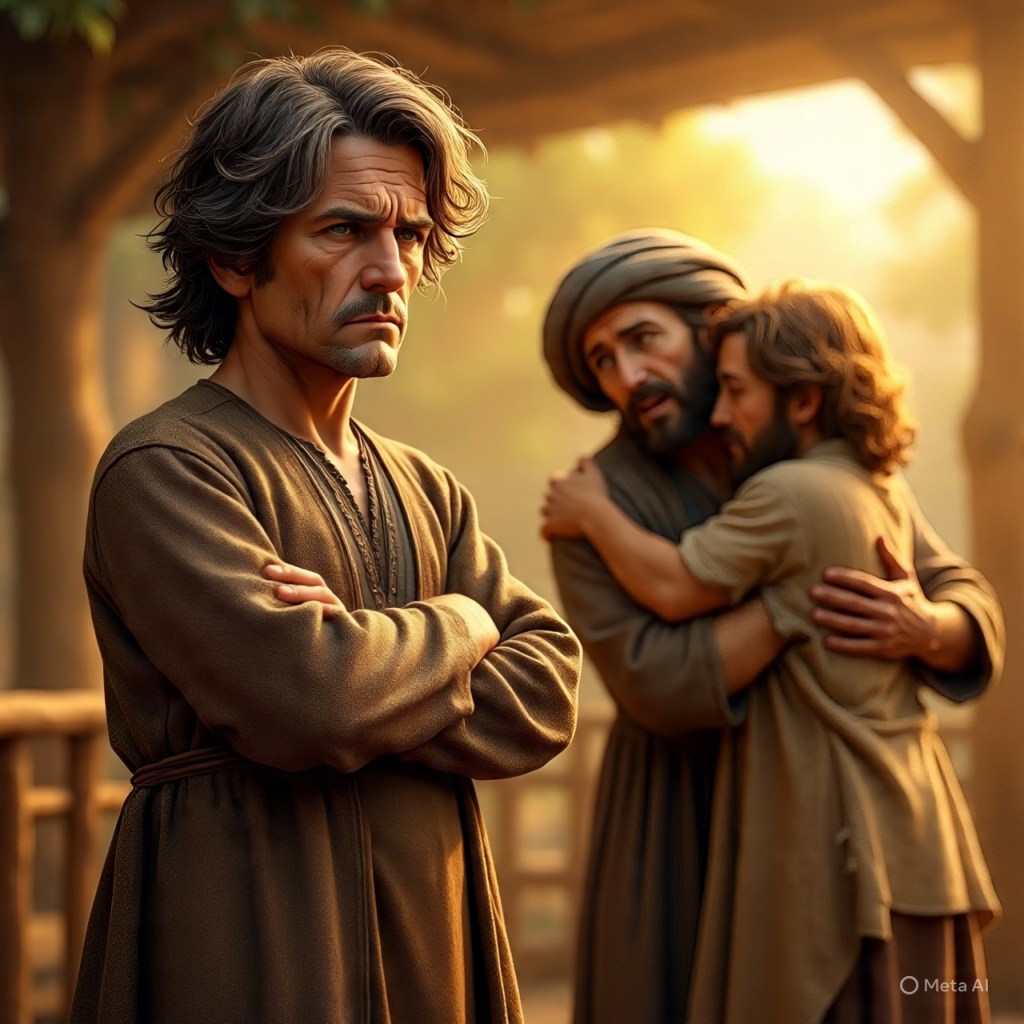
“Meanwhile, the older son was in the field. When he came near the house, he heard music and dancing.
So he called one of the servants and asked him what was going on. ‘Your brother has come,’ he replied, ‘and your father has killed the fattened calf because he has him back safe and sound.’
“The older brother became angry and refused to go in. So his father went out and pleaded with him. But he answered his father, ‘Look! All these years, I’ve been slaving for you and never disobeyed your orders. Yet you never gave me even a young goat so I could celebrate with my friends. But when this son of yours who has squandered your property with prostitutes comes home, you kill the fattened calf for him!’
“‘My son,’ the father said, ‘you are always with me, and everything I have is yours. But we had to celebrate and be glad, because this brother of yours was dead and is alive again; he was lost and is found.’” – Luke 15:25-32
The parable of the prodigal son is one of Jesus’ most popular. Much of the exposition on it has focused on the younger son, who took his share of the father’s estate, left home to a distant country and lived riotously. By the time he returned, he was spent and beneath a slave. He asked to be treated as such. His father would have none of it, and he threw a hastily arranged party to welcome the lost but found son home.
But the story does not end with the younger son’s return.
Enter the older son – often overlooked, yet just as revealing. His reaction to the events of that day becomes the focus of this reflection.
Offended By Grace
This subtitle sounds somewhat oxymoronic, but that’s what the older son felt. Jesus said he came near the house to the sound of music and dancing. Shouldn’t he have just gone in to find out why his father’s house was merry? Shouldn’t he have first rejoiced with those who were rejoicing? He inquired of one of the servants and was told, ‘Your brother has come, and your father has killed the fattened calf because he has him back safe and sound.’ News that should have sent him running into the house to throw his arms around his kid brother and join the celebration instead left him angry. He wouldn’t even go into the house. He believed in justice and fairness so strongly that it crowded out mercy and love. May we have a balance in our concepts.
He believed in justice and fairness so strongly that it crowded out mercy and love.
His reaction may seem surprising – but Scripture shows he is not alone. Jonah was similarly offended when God spared the city of Nineveh from destruction following their repentance (Jonah 4:1-3).
Have you felt like certain sinners do not get the punishment that, in your judgment, their sins deserve? ‘Why does God spare and even bless them?’ you may have thought. Asaph, the Psalmist, said his feet had almost slipped when he saw the prosperity of the wicked. “They have no struggles;” he said, “their bodies are healthy and strong. They are free from common human burdens; they are not plagued by human ills” (Psalm 73: 4-5). He envied them.
If we were not also offended by grace, perhaps we would be out and about with the gospel, so that the unbelieving may come to faith and escape the coming wrath. It was this offence at grace that made Jonah run away from bearing the message of salvation. May we prove that we are different by our attitude to the spread of the gospel.
In the end, he was not just offended by grace – he was out of step with the heart of his father.
He was not just offended by grace – he was out of step with the heart of his father.
But the older son’s problem runs deeper than offence – it reveals how he understood his relationship with his father.
The Slave Mentality: Relationship As a Transaction
That reaction exposes something deeper: how the older son saw his place in the father’s house. When his father goes out to plead with him, the older son lets out his frustration: “All these years I’ve been slaving for you.” He was a son, the heir apparent, but he saw himself as a slave. He viewed his relationship with his father as a business transaction or a job rather than a loving bond. He reduced obedience to a transaction: “[I] never disobeyed your orders.” It was so that his father would be in his debt and he could demand a settlement anytime. He seized the opportunity when it came: “You never gave me even a young goat so I could celebrate with my friends.” His life of duty was driven by a desire for a reward (a “young goat”) rather than joy in his father’s company.
Quit living like a slave; live like an heir.
Why are you in God’s service? Are you in it out of love for him or for the “young goats” that you hope to get from him? Like the older son, such a mindset will lead to frustration and anger at God when one does not get the temporal rewards hoped for on earth. The greatest commandment is to love God with all that we are (Matthew 22:37). That love must be the motivation for all our labours. It is the labour of love that God doesn’t forget (Hebrews 6:10).
The older son missed the point that he was already an heir. The father reminded him, “Everything I have is yours”, showing that his hard work didn’t earn his inheritance – he already had it by being a son. Paul said “we are heirs—heirs of God and co-heirs with Christ” (Romans 8:17). All that God has lined up for Christ is also yours as his adopted child. Quit living like a slave; live like an heir.
But this distorted view of his relationship also shaped how he saw others – especially his brother.
Self-Righteous Pride and Superiority
The older son’s anger reveals a heart that feels more “deserving” than others. While the younger son’s sin was one of rebellion, the older son’s sin was one of resentment and self-righteousness.
So angry he was that he denied us the opportunity of knowing his younger brother’s name. He dismissively refers to him as “this son of yours” to his father. He proceeds to measure his own worth by contrasting it with his brother’s failures (“who has squandered your property with prostitutes”), failing to see his own inner lostness.
He measured his worth by his brother’s failures.
This even raises a troubling possibility: he may have known more about his brother’s life than he let on. He seemed to know what he had spent his inheritance on (“who has squandered your property with prostitutes”). That he left his father longing for the return of his lost son also reveals his heart. If so, his silence is telling. It reflects a hardness of heart not unlike that of Joseph’s brothers, who allowed their father to grieve for a son they knew was still alive.
This attitude mirrors the very audience Jesus had in mind. In Luke 14, the religious leaders (Pharisees) grumbled about him eating with “sinners.” Jesus came for sinners (and that is all of us); let not self-righteousness stop you from seeing sinners as he did.
But the danger is not only outward attitude – it is an inward condition.
Lost At Home
This brings us to the heart of the matter: the older son was lost – while still at home. Often called the “other prodigal,” the older son represents those who are physically present but spiritually distant from the Father’s heart.
Perhaps this is the greatest danger in the story. It is a warning that one can stay “home” (in the church or family) and still be lost – lost in duty and activity and self-righteousness and lovelessness. Activity is not the same as intimacy. Paul said, “If I deliver my body to be burned, but have not love, I gain nothing” (1 Corinthians 13:3). This son remained at home but gained nothing. It didn’t show until the day his lost brother returned home.
He was with the father.
But away from his heart.
He knew nothing of his father’s heart cry or daily hopes. He did not understand what his father would give up everything to have. That the father was the first to see the returning son tells how much he longed for his return. The actions that followed confirm this; yet his one remaining son was oblivious to this.
The older son was lost—while still at home.
What is the state of your heart? Is it ruled by comparisons to others whom you see as less devoted than you are? Paul said, “When they measure themselves by themselves and compare themselves with themselves, they are not wise” (2 Corinthians 10:12). Are you offended by the mercy God extends to certain people you think are deserving of worse? Do you know the cry of God’s heart, O believer? May we not be in church, full of activity, while ‘serving’ God with wrong hearts.
The Unresolved Ending
And then, the story ends – without resolution. The older son is standing outside in the cold, refusing to join the party. Perhaps Jesus leaves it open-ended to challenge the “older brothers” in the audience to decide if they will ever choose to come inside.
The question is not how the story ends – but how yours will.
Will you remain outside, holding on to fairness and pride?
Or will you come in and join the celebration of grace? Jesus said, “There is rejoicing in the presence of the angels of God over one sinner who repents” (Luke 15:10).
In this house, grace is a gift—not a wage.
As you come in, know that in this house, grace is a gift, not a wage. Whether someone has been a “misfit” or a “saint,” everyone stands equally in need of the Father’s unconditional love to enter the celebration.
 World Changers Magazine