
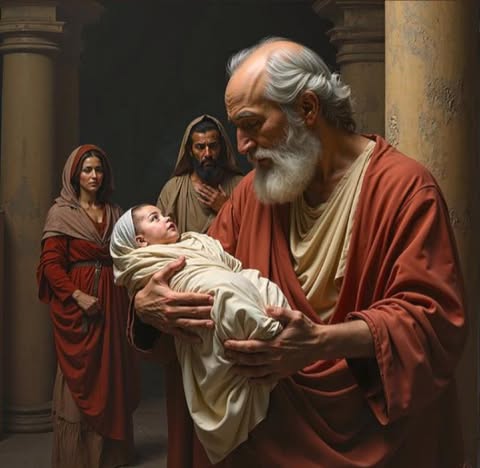
Photo Credit: Pinterest
‘Now there was a man in Jerusalem called Simeon, who was righteous and devout. He was waiting for
the consolation of Israel, and the Holy Spirit was upon him. It had been revealed to him by the Holy
Spirit that he would not die before he had seen the Lord’s Christ. Moved by the Spirit, he went into the
temple courts. When the parents brought in the child Jesus to do for him what the custom of the Law
required, Simeon took him in his arms and praised God, saying:
“Sovereign Lord, as you have promised, you now dismiss your servant in peace.
For my eyes have seen your salvation,
which you have prepared in the sight of all people,
a light for revelation to the Gentiles and for glory to your people Israel.”’ – Luke 2:25-32
The Consolation Wrapped in a Child
Simeon was waiting for the consolation of Israel – the promised Saviour and deliverer. The Holy Spirit
had revealed to him that he would not die before he had seen the Lord’s Christ. On this appointed day,
moved by the same Spirit, he entered the temple courts just as Joseph and Mary brought in the child
Jesus to fulfil the requirements of the Law. Taking the child into his arms, Simeon praised God and declared that the promise of a lifetime had been fulfilled. What he saw before him did not resemble the expectations of a nation longing for deliverance. There was no outward majesty, no visible power – only a fragile infant, wholly dependent on his parents. This tiny, helpless, breast-suckling, parent-dependent child was the one Simeon – after decades of waiting for Israel’s national deliverer – declared to be the salvation God had promised: “My eyes have seen your salvation.”
The consolation of Israel was not clothed in glory, but wrapped in flesh.
In that child, God had prepared salvation in the sight of all peoples: a light for revelation to the Gentiles
and the glory of Israel. The consolation Simeon had waited for was not wrapped in political strength or
military triumph, but in flesh and weakness – a Saviour given before he was revealed. This infant, who
had no beauty or comeliness to attract us to him, was the very person that Simeon saw as the salvation
from the Lord. Was that what this old man spent his life waiting for?
Simeon’s words were not the product of sentiment but of revelation. What he saw that day in the
temple was not merely a child, but the very salvation of God. His story confronts us with a searching
question: What do we see when we look at Jesus?
The Eyes of Faith
What Simeon saw was no ordinary thing. Flesh and blood did not reveal to him that the baby he saw and
handled was the Word of life himself. It takes more than natural human sight to see that child as the
promised consolation. The same Spirit that revealed to him many years ago that he would not die before
he had seen the Lord’s Christ was the same Spirit that told him who he was seeing was indeed the Lord’s
Christ. Simeon was content to pray: “Sovereign Lord, as you have promised, you now dismiss your servant in peace.” He could rest in peace because he had seen the salvation of the Lord.
Flesh and blood cannot reveal the Saviour; only the Spirit can open blind eyes.
Why is that an important matter? Being saved comes from seeing Jesus, through the eyes of faith, as the
Saviour. Many will perish because of their blindness to this truth: Jesus is no ordinary man; he is the
Saviour. He later declared himself to be “the way, the truth and the life” and that no one accesses the
Father except through him (John 14:6).
This wrong way of seeing is what got our first parents and the rest of us into trouble. It was when the
woman “saw that the fruit of the tree was good for food and pleasing to the eye, and also desirable for
gaining wisdom” that she took some and ate and also gave to her husband (Genesis 3:6). If anyone will
be saved from the results of that seeing, they must see this Jesus as the Saviour.
Many will perish, not for lack of eyes, but for lack of sight.
What You See is What You Get
Simeon could depart in peace and truly rest in peace because he had seen the Lord’s Christ. This seeing
is believing that this Jesus is the Christ, the holy one of God. This seeing is esteeming him as the most
precious treasure that when you find in a field, you go away and sell all your possessions and buy that
field so that you can have him (Matthew 13:44-46). This seeing is loving him with all your heart, all your
soul, all your mind and all your strength (Mark 12:30).
When you look at Jesus, who do you see? Who you see determines who you’ll get. Many among the
Jews looked at him and saw a carpenter’s son (Matthew 13:55). They got nothing more than a mere
carpenter’s son. The Pharisees saw a blasphemer (Luke 5:21), and instead of receiving forgiveness for
their sins, they piled on more sins. Others looked and saw a miracle-worker who could multiply bread,
and all they got was perishable food (John 6:26-27). Two men were on the cross on either side of him.
One saw him as a fellow criminal and went into eternity in his sins. The other saw God and the Saviour.
“Don’t you fear God”? he asked. “Jesus, remember me when you come into your kingdom,” he prayed,
and that very day he was with the Lord in paradise (Luke 23:40-43).
One thief saw a criminal; the other saw a King—and eternity turned on that sight.
Once, Jesus asked his disciples who people said he was. The import of the question was who they saw
when they looked at him. Some saw John the Baptist, others Elijah, and still others, Jeremiah or one of
the prophets. And there were many prophets. Jesus asked them personally and pointedly: “Who do you
say I am?” The Master was asking in effect, “You who have been following me, who do you see when
you look at me”? Peter told him what his eyes had seen: “You are the Messiah, the Son of the living
God” (Matthew 16:13-16).
Let me ask again, when you read the Scriptures, who do you see? Some even diligently study the
Scriptures, thinking they might have eternal life, yet they refuse to come to the Saviour, who the
Scriptures testify about, to have life (John 5:39-40). We give ourselves to Christ in proportion to how precious we see him to be.
The Eyes of the Heart Enlightened
It is not enough to have eyes – they must be able to see. In Jesus’ day, the people saw him with physical
eyes but he still referred to them as being blind (Matthew 23:24). They needed the eyes of their hearts
to be enlightened so they could see him for who he truly was. When Peter described Jesus as “the
Messiah, the Son of the living God”, Jesus replied that that was not a revelation from flesh and blood but
from the Father in heaven (Matthew 16:17). No man, dead in transgressions and sins (Ephesians 2:1),
sees Jesus as Saviour, apart from the life-giving work of God. A dead man is blind after all. Only the
resurrection power can bring the dead back to life and grant them sight to see the Saviour.
Only the Holy Spirit has the salve that opens blind eyes.
Paul prayed for the Ephesians, that the eyes of their heart may be enlightened so that they may know
the hope of God’s calling, the riches of his glorious inheritance in the saints (Ephesians 1:18). Only the
Holy Spirit has the salve that can open anyone’s eyes to see Jesus as Saviour.
When Eve saw the fruit as beautiful and desirable, she reached out for it. If the eyes of your heart are
enlightened, only then will you see Jesus as Saviour; as beautiful beyond compare; as glorious and all-
satisfying and more precious than all else. This is what will make you love him and give yourself wholly in service to him, just as Eve reached out to the beauty she saw.
Seeing is a Work of God
For the prophet Isaiah, it was in the year that King Uzziah died that he saw the Lord, high and exalted,
seated on a throne (Isaiah 6:1). Perhaps you, too, need something to die so that you may see the Lord.
What is it that needs to die?
Paul says, “The god of this age has blinded the minds of unbelievers, so that they cannot see the light of
the gospel that displays the glory of Christ, who is the image of God” (2 Corinthians 4:4). That is why
seeing Jesus as the Saviour is a miracle. It requires the almighty God to make war against the god of this
age so that the blind can receive sight. The purpose of this sight is not to see any other thing but Jesus as
Christ, the Saviour. Apart from your initial salvation, your continuous walk and service also depend on your continuously seeing him as Lord and Saviour. The extent to which you give yourself and your resources to him depends on who you see him to be – the overwhelming preciousness, the surpassing worth, the supreme advantage, the priceless possession or something less.
The ultimate consolation of the believer is this: we shall see him as he is.
Pray Paul’s Prayer
Are you trusting God for anyone’s salvation? Why they are yet to be saved is because they are blind to
the Saviour. Pray that their eyes may be opened and they may see this Jesus as the salvation their soul
needs. For your own self, too, let Paul’s prayer for the Ephesians be your prayer, that the eyes of your heart may be enlightened continually and progressively. Pray that the man of Calvary would increasingly be precious to you so that you may increasingly give yourself to him. Then one day, the ultimate consolation, the great hope of all believers, will come true: “When he shall appear, we shall be like him;
for we shall see him as he is” (1 John 3:2).
Visit our website to register for the 2026 World Agents of Change Conference…
 World Changers Magazine